
systeme.io
Not Every School Has Deep Pockets But Every School Can Innovate. Here’s Why…
Let’s start with a truth that isn’t easy to hear: life isn’t fair. Access to high standards of education isn’t equitable. Some schools operate with generous budgets, modern campuses, and resources that make innovation almost second nature.
Others, particularly low-fee or resource-constrained schools, face very different realities. But innovation doesn’t have to be about money.
In fact, the most transformative innovations often come from necessity, creativity, and courage. Not deep pockets. For many schools, large-scale structural or technological innovation isn’t an option. For them, innovation looks different, often smaller in scale, but no less meaningful.
In my earlier blog, I explored how culture and trust shape schools. Following on from these topics, I see two additional factors that are equally crucial in innovation: capacity and mindset.
Capacity
Capacity is about what a school can do with its people and resources. For some low-fee schools, recruiting staff is the top priority. But it takes a special kind of teacher to bring creativity into learning when even the most basic resources are lacking.
These teachers do more than teach; they inspire. They look beyond budgetary constraints and find ways to spark engagement.
A simple example is a teacher rearranging desks from rows into groups to encourage discussion and collaboration. This small change can have a profound impact on learning without costing a penny.
Mindset
Mindset, on the other hand, is about belief and the belief that innovation isn’t a luxury reserved for the well-funded.
Teachers and leaders with a growth mindset see challenges as opportunities. They ask, “How can we do this differently?” rather than “Why can’t we?”
As one educator once said, “Innovation is not a luxury; it is a mindset that belongs in every classroom, not just in schools with deep pockets.”
Small Step Innovation
So, what does “small-step innovation” look like in practice? Here are a few examples I’ve seen make a real difference:
Curriculum review: Embedding inquiry-based learning within existing structures encourages curiosity and problem-solving, without requiring major investments.
Student-led initiatives: Cultivating a culture where students act as change leaders transforms learning. Students identify issues, for example highlighting sustainability, and explore solutions, developing critical thinking and presentation skills. Teachers become facilitators, guiding rather than instructing.
Triangulated progress meetings: Replacing traditional parent-teacher meetings with sessions where students review their own progress alongside parents and teachers shifts the focus. Students share examples of their best work and set goals for their next steps. This approach builds accountability and reflection while strengthening home-school partnerships.
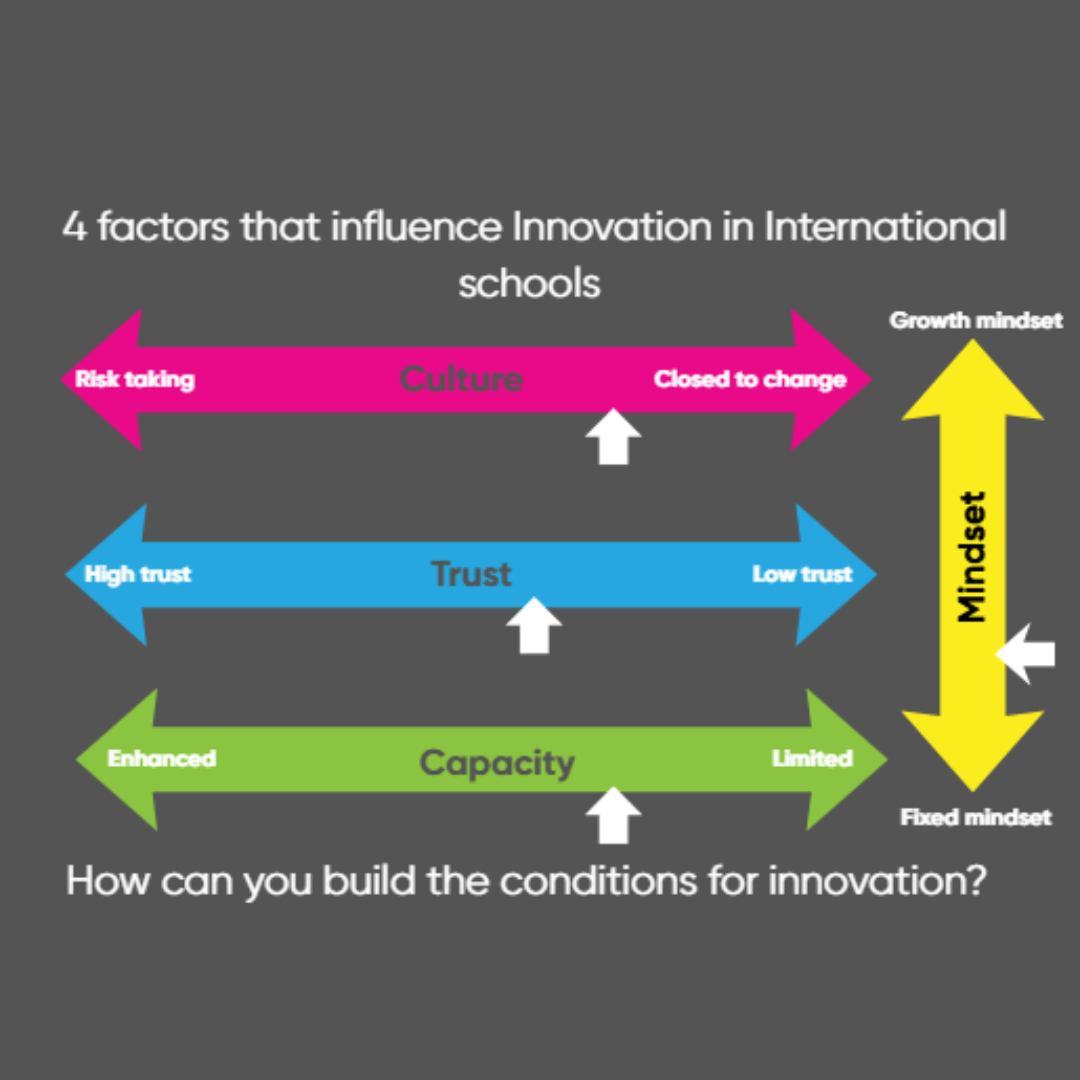
Over the next few days, I invite you to observe life in your school through these lenses. Ask yourself:
Where does my school sit on the continuums of culture, trust, capacity, and mindset?
Which departments are creating conditions that optimize innovation?
What barriers exist, and how might we overcome them?
Remember: “Every innovation begins with someone brave enough to test one small idea.”
Education leadership isn’t about ego but is about courage and purpose. It’s about prioritizing what truly shifts the dial and positively impacts students’ life chances. At its core, effective leadership is inclusive, celebrating innovation even in schools without vast budgets. It’s about connection over competition, sharing successes, and learning from each other.
This is why I created Making It Happen, not only to give leaders what so many need but rarely have: a confidential, neutral space focused entirely on you but to also shine a light on innovation, inspire leadership, and celebrate those making a difference regardless of resources. I invite you to share your stories: the initiatives that worked, the ideas you tested, and the impact you’ve seen. Together, we can learn and grow.
Leadership isn’t about doing something flashy. It’s about showing up, taking small steps, and having the courage to make a difference where it counts. Innovation is possible everywhere, if we choose to see beyond constraints and focus on what truly matters.
If this post struck a chord, you’ll love my Framing Leadership Differently monthly newsletter. You will automatically receive this when you sign up for my free 6-step guide to Navigating a New Culture with Confidence. You’ll find bite-sized insights, fresh perspectives, and a light-hearted dash of humour- just the antidote you need after a week of fire-fighting. Dropped straight into your inbox, it’s your moment to grab a coffee (or a chai), lean back, and enjoy a lighter take on leadership.

Hi, I’m Lynda Haynes McCartney, also known as The Quiet Coach.
I founded Making it Happen to create what so many leaders need but rarely have; a confidential, neutral space focussed entirely on you. Whether you are stepping into a new role, facing a complex challenge, or wanting to reconnect with your values and purpose, this is where clarity replaces overwhelm and insight becomes action.

Download my FREE '6 Step Guide to Navigating a New Culture with Confidence'
The Quiet Coach's guide for leaders stepping into new roles in International schools
systeme.io
INFORMATION

CONNECT WITH ME ON:

TAKE THE NEXT STEP
© Making It Happen | Lynda Haynes- McCartney 2025. ALL RIGHTS RESERVED
Website created by ThatWomanTech